Maximize your conversion rate: Turn traffic into incremental revenue
Attracting visitors is only half the battle. If they don't buy, your marketing budget is essentially wasted. High bounce rates don't just hurt your analytics; they hurt your bottom line. To drive real growth, you need to turn passive traffic into active buyers. But how do you systematically improve your conversion rate, and which levers actually move the needle?
What is a conversion rate?
A “conversion” is any desired action a visitor takes on your website – from making a purchase to signing up for a newsletter. The Conversion Rate (CR) is the Key Performance Indicator (KPI) that measures your success. It tracks the percentage of total visitors who actually complete this goal. Simply put: it tells you how effectively your website turns traffic into value. If the rate is low, you are leaving money on the table.
The business case for CRO: Unlock untapped value
With industry averages hovering around 2-3%, nearly 98% of your traffic leaves without buying. This represents a massive, untapped opportunity. Conversion Rate Optimisation (CRO) turns this wasted traffic into revenue. Rather than burning budget on acquiring new visitors, you extract more value from the users you already have. The result is a more efficient business model: lower Customer Acquisition Costs (CAC), higher ROI, and measurable incremental revenue.
NOTE
Benchmarks vary by industry
While the global average conversion rate sits around 2-3%, a “good” rate is highly dependent on your specific sector. High-ticket items naturally convert at lower rates than fast-moving consumer goods. However, the opportunity remains the same: nearly 98% of traffic goes untapped. Optimizing this traffic – regardless of your industry baseline – is the most effective way to lower acquisition costs and drive incremental revenue.
Establish the foundation for growth
Before implementing changes, you must identify the root causes of drop-offs. Optimization is not a quick fix – it is a continuous, systematic process. To succeed, stop guessing and start diagnosing. A structured approach ensures that every change you make contributes to long-term performance.
Funnel analysis: Identify the weak points
There is always a reason why visitors abandon a purchase. To fix the leaks in your funnel, you must uncover the “why” behind the drop-off. Start by auditing your user journey with these critical questions:
Value proposition: Is the added value of the product unclear from the user’s perspective?
Usability friction: Is the checkout process hidden or overly complex, blocking the final transaction?
Intent mismatch: Did the user expect something different based on their search query or ad click?
The next step: Don’t rely on guesswork. Use A/B testing and user surveys to diagnose the root cause with real data.
Identify common friction points
Conversion isn’t just about the product; it’s about the experience. Several technical and psychological factors can silently kill your conversion rate. Check your site for these common barriers:
Slow page speed: Long loading times cause immediate bounce
Poor usability: Navigation that is confusing or not mobile-friendly
Technical errors: Broken links, 404s, or crashes
Payment friction: Too few payment options at checkout
Lack of trust: Missing trust signals (reviews, seals) or questionable credibility
Content quality: Spelling mistakes or overly complex copy that confuses the user
The fix: Before testing complex strategies, ensure these basics are solid. Optimizing these fundamental factors aligns your site with user expectations and removes the friction that blocks the sale.
NOTE
What is a long loading time?
There is no universal answer, as speed is often a matter of context. A user on a poor mobile connection might be patient, while a desktop user expects instant results. However, to move beyond subjective feelings, you can rely on Google’s Core Web Vitals for objective benchmarks:
LCP (Largest Contentful Paint): Loading the main content in under 2.5 seconds is considered “good.”
FID (First Input Delay): If the site responds to interactions within 100 ms, Google rates this as “good.”
Defining the metrics:
LCP (Largest Contentful Paint): Measures the time it takes for the main visible content to load. It indicates when the page becomes useful to the user.
FID (First Input Delay): Measures the responsiveness – specifically, how long it takes for the site to react to the first interaction, such as a click or tap.
You can audit your current performance using Google PageSpeed Insights. However, remember that these scores are technical proxies. While a good score correlates with higher conversion, the user’s subjective experience is the final reality check.
Target group alignment
Technical optimization is only the baseline. To drive conversions, your content must resonate with the specific needs of your audience. Efficient evaluation requires clear data points regarding user intent and behavior. Use these questions to guide your analysis:
Who is the primary target group?
What are the specific needs of these visitors?
Where does the traffic come from?
Which pages are most frequently visited?
How long is the average session duration?
What is the current conversion volume?
Concrete tips to increase your conversion rate
Optimization starts with clear goals. Before you begin, define exactly what you want to achieve. In e-commerce, the focus is typically on driving incremental revenue. To reach this goal, you need a strategic approach rather than isolated tactics. Regardless of your specific target group, we recommend the following proven steps:
Reduce the bounce rate
Beyond technical performance, simplicity is the key to conversion. The ordering process must be intuitive and friction-free. To ensure your checkout is optimized, verify that you can answer “yes” to the following questions:
Can the user easily add items to the cart?
Is the path from cart to checkout intuitive?
Do you offer a wide range of payment options (e.g., PayPal, bank transfer)?
Is shipping information displayed clearly and early?
Are all form fields labelled clearly?
Is guest checkout available (purchasing without registration)?
Remember: Momentum matters. The deeper a user gets into the funnel, the more committed they are – provided you don’t put obstacles in their way.
Prioritize usability
Usability is the foundation of conversion. If your site is complex, navigation is unclear, or products are hard to find, users will simply leave. To prevent high bounce rates, you must remove friction and make the user journey as intuitive as possible.
Optimize your content
Content is a powerful conversion lever that is often underestimated. To drive sales, your product and category texts must offer genuine value. The goal is to be comprehensive, yet concise: provide all specific details the user needs, but avoid unnecessary fluff. Crucially, avoid unstructured “walls of text” – they overwhelm visitors and kill engagement.
Convince with visuals
Text alone is not enough. High-quality product images are critical for conversion. Use detailed visuals that show the product clearly to speed up the buying decision. Crucially, ensure high resolution – pixelated or blurry images look unprofessional and immediately erode user trust.
Leverage social media and content
Meet your audience where they are. Platforms like Instagram or industry blogs are powerful entry points to your funnel. Beyond driving traffic, use these channels to build trust through “Social Proof.” Showcase positive customer reviews and, crucially, respond to criticism with transparency and professionalism. displaying competence in public channels is a strong signal of reliability to future buyers.
Build trust and security
Visitors need to feel safe before they buy. While quality seals (trust badges) provide visual reassurance, tangible policies are what truly reduce perceived risk. To maximize confidence and conversion, consider implementing:
Money-back guarantees
Free returns
Diverse payment options
Minimize data collection
Limit your forms to the absolute essentials required for the transaction. Requesting irrelevant information raises privacy concerns and makes a business appear intrusive. If users feel the data request is unjustified, they will lose trust and abandon the process.
Optimize page speed
Speed is currency. If your landing page loads slowly, users lose patience instantly. The result is a spike in bounce rates and a drop in dwell time – both of which destroy conversion potential. Ensure your technical performance is best-in-class; if your site is lagging, immediate technical optimization is required.
Drive conversions with Sovendus Optimize
Sovendus Optimize provides seamless, easy-to-integrate extensions designed to maximize your shop’s performance. You have full control – simply choose the modules that fit your strategy:
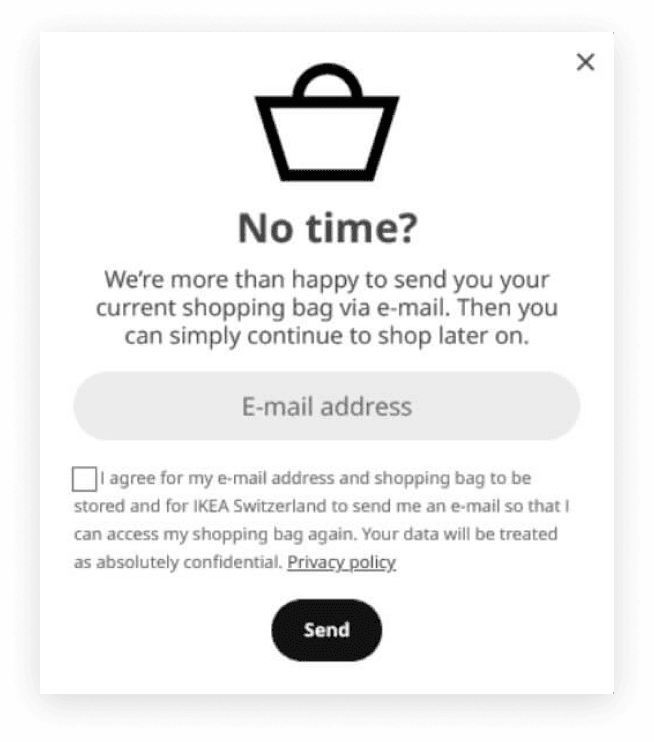
Save cart for later: Not every visitor is ready to buy immediately. Our widget allows users to email their shopping basket to themselves – bridging the gap between devices and ensuring they can complete the purchase later.
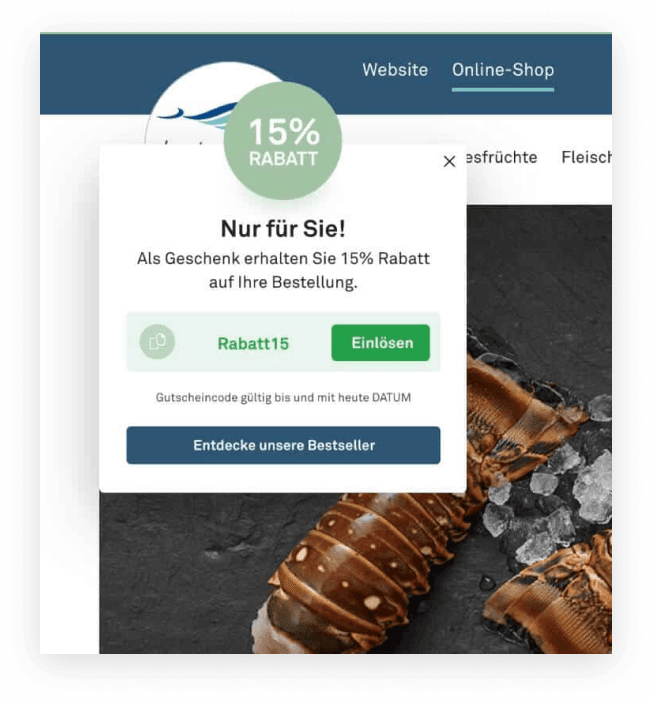
Targeted incentives: Sovendus Optimize provides seamless, easy-to-integrate extensions designed to maximize your shop’s performance. You have full control – simply choose the modules that fit your strategy: Close the deal faster. Use the widget to display timed discount promotions that motivate hesitant users to finalize the transaction immediately.
Prevent search abandonment
Don’t let your paid traffic bounce back to Google to find a competitor. If a user arrives via paid ads and attempts to leave using the back button, Sovendus Optimize intervenes with a targeted discount code. This strategy secures the sale and protects your acquisition investment – ensuring you don't pay for the same lead twice. Additionally, by keeping the user on the site, you improve dwell time – sending a positive signal to search engines.
Real-time objection handling
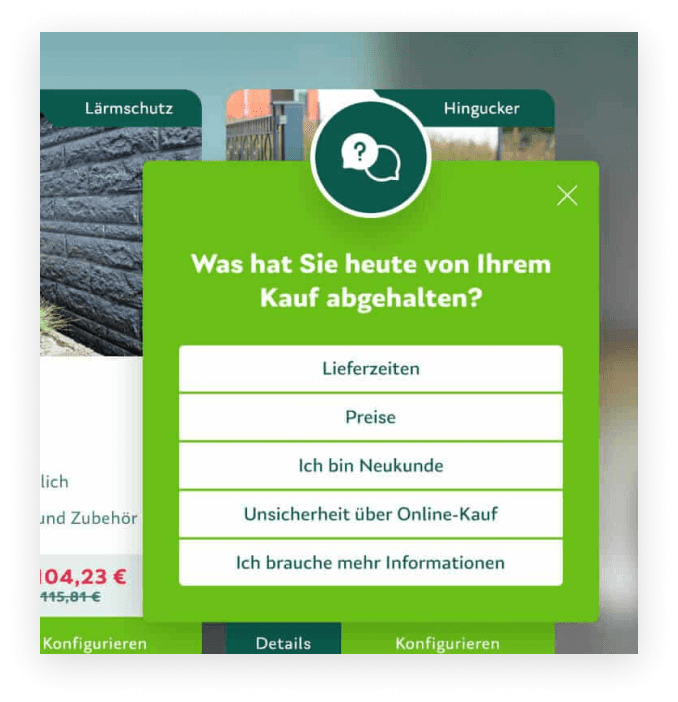
Turn hesitation into action. The “Problem Solver” widget identifies exactly why a visitor is not buying and allows you to react instantly. Through an interactive widget, users select their specific barrier, and the system immediately offers a tailored solution – whether it is a helpful guide or a targeted promotion. This not only resolves concerns in real time to finalize the purchase but also aggregates critical behavioral data, giving you the insights needed to systematically improve your KPIs.
The Sovendus solution aggregates the critical metrics you need to optimize performance. We collect and analyze:
Transaction ata: Order volume and total value
Cart contents: Data required to trigger precise recovery emails
Campaign performance: Granular details on impressions, clicks, and conversions
Financial KPIs: Clear tracking of costs, revenue attribution, and ROI
Ready to optimize your performance? If you want to elevate your conversion rate with the powerful extensions of Sovendus Optimize, let’s talk.
Who benefits from optimization?
In principle, every business benefits from greater efficiency. However, for shops facing declining revenue or rising bounce rates, it is not just an opportunity – it is a necessity. These metrics indicate structural friction points that require immediate intervention. If your numbers are slipping, you cannot afford to wait.